


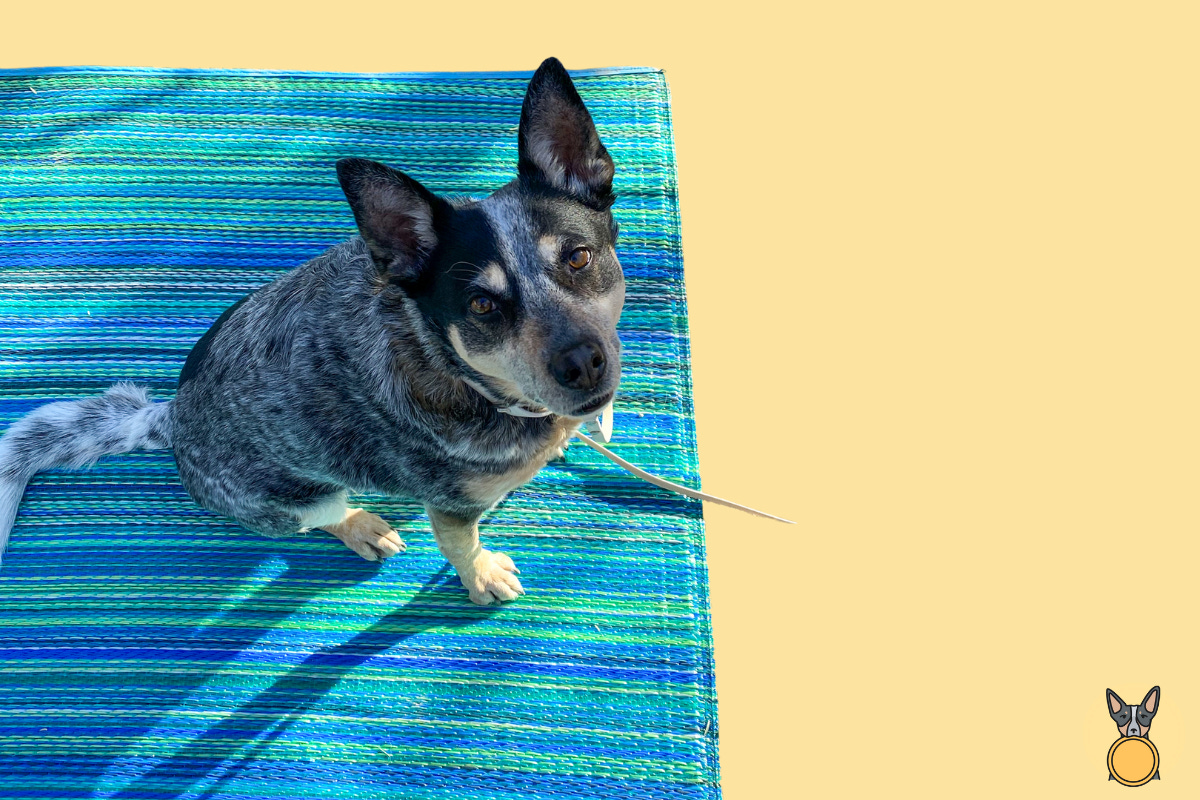
Earlier this morning, while we ate breakfast outside, Scout languidly watched every dog who walked past our campsite. We were ready as always to offer her help if she needed it. But she never came close to needing it. As she sat on the picnic table bench next to me, burrowing her nose in the crook of my arm to ask for a bite of egg sandwich, I repeatedly told her how perfect she was. (I also repeatedly gave her bites of egg sandwich.)
“She’s the very best dog nowadays,” Sean agreed. The words were nothing new—we probably have a version of this conversation two or three times a day—but my heart still swelled.
Now, a couple hours later, Scout has started huffing under her breath when other dogs go by. She’s regulating her reactions pretty well overall, but we’ve needed to intervene twice. She is undoubtedly more on edge than she was at 8 am.
What changed? We had a couple unpleasant experiences—“campground chaos,” I call it—and as a herding-dog pattern-mapper extraordinaire, Scout can’t help but hold onto the stress.
The first was when the adorable-but-should-not-have-been-off-leash corgi from across the road darted into our campsite. He thankfully wasn’t too intent on actually greeting Scout, and both Sean and his owner stepped in to grab him quickly. I was able to tell our heeler to jump on the table out of the way, and following a couple under-her-breath growls the whole thing was over. (Totally appropriate when you are surprised in your own space.) She watched the corgi and his Australian shepherd sibling more closely after that, but soon we all moved on.
The second was when Sean and I had started our work days. I smiled over my computer screen at an older man walking by with his two dachshunds; I think he took it as an invitation to come say hello. He and his dogs walked into our site toward the rug where Scout was lounging. I wasn’t able to step in soon enough—she huffed at their approach then progressed to a few full barks. Still, the man and his dogs kept moving closer. “Is she friendly?” he asked me over her growls. (I did not find this funny at the time, but in hindsight, the sheer obliviousness holds some hilarity.)
“No, she isn’t,” I replied. “She’s scared.”
“Okay, I won’t come closer,” he said. But he also didn’t leave. He stood there, dachshunds pulling at the end of their leashes, waiting for who knows what to happen.
Eventually Sean (who is much better at any sort of socially awkward situation than I am) said politely but firmly: “If you don’t mind, I’m on a work call.” The now-visibly-disgruntled man dragged his dogs away.
And after that—two separate experiences of unfamiliar dogs coming all the way into her space—Scout stayed wary. I’m confident she’ll return to her baseline soon. (As I write this, she is flopped on her side in the dirt next to my lawn chair, seeming to settle more fully under the late morning light.) But I’m also not surprised those situations shook her. Usually we prioritize lots of repetitions of “dog walks by, nothing happens, all is calm”—and those stack atop one another, year over year, enabling her to continue feeling comfortable in the presence of triggers. Once in a while, though, we can’t avoid the chaos—and then those experiences stack atop one another too, threatening all our confidence just a bit.
No one meant any harm this morning. The corgi’s owner was apologetic; they’ve diligently kept both their dogs on tethers ever since. The older man probably thought he was being friendly; although I stand by the fact that walking directly into someone else’s campsite is rude, it is plenty common to say hi to new folks in campgrounds.
For my part, I’m feeling a familiar mixture of emotions: Proud of Scout! While these situations do stress her out, I don’t expect the effects to last longer than a few hours at most. Frustrated? by the unpredictability of the world we live in. Bewildered, a little, by some people’s very different expectations of social norms. And hyperaware, all over again, of how easy it is to impact someone else’s experience in a shared space—even, and maybe especially, when you don’t think what you’re doing is any big deal.


