


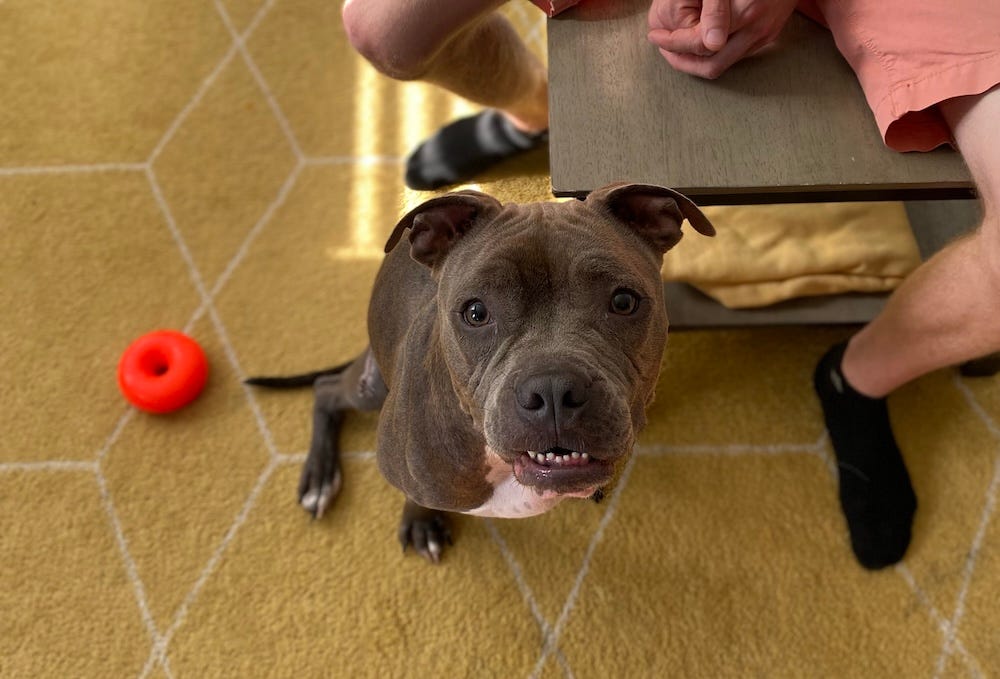
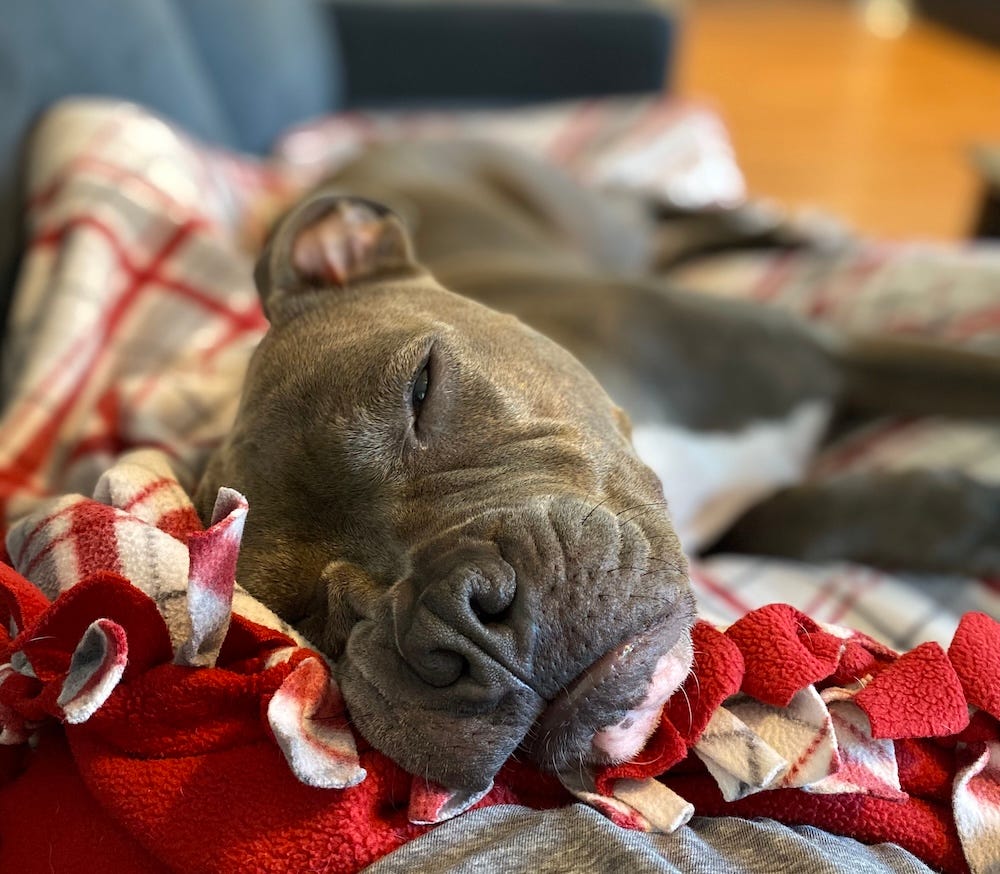
“Miss Batty” looked like E.T. the Extra-Terrestrial, all wrinkles and curious-sad eyes. She was heartworm positive (so common as to be expected for dogs in the southern shelter system) and recovering from surgery to fix a broken leg with a few ounces of metal (not as routine but still less rare than you might think). Because the bustling SPCA kennels were no one’s idea of a healing environment, Miss Batty was looking for a foster home’s living room instead.
I’d like to say I loved Batty instantly. In a way I suppose I did—the shallow admiration I feel immediately upon seeing any new creature, especially a canid—but I was also afraid of her. Not of her blocky head or her unknown-only-guessed-at behavior around other dogs or her medical prognosis. None of that felt overwhelming; I figured we knew enough about training and management and risk assessments to get by. No, I was afraid of what welcoming her would do to Scout, my nervous blue heeler who’d always had us to herself. I was afraid of what Batty’s ability (or, god forbid, inability) to thrive under my roof would say about me.
But the fear tasted a bit like excitement, too. I wanted to get involved in the rescue world beyond walking shelter dogs a couple hours each week. I wanted to know if Scout trusted me as much as I hoped she did by that point. I wanted to see Sean, who still insisted he was “not a dog person,” lose his heart to another four-legged creature.
We’ll take her, I replied to the SPCA’s foster coordinator. Does tomorrow morning work?
On April 28th, 2022—three weeks after Sean and I got married and three-ish years after I’d adopted Scout—we humans drove forty-five minutes to pick up Miss Batty (who we decided was actually more of a “Val” from the Ender’s Game book series). Val was instantly affectionate and endearingly clumsy and seemed like she might have needed to be lifted into our sedan’s sandy back seat even without the broken femur on scene. She felt woozy in the car and cried the whole way home, showcasing a sliver of the hilarious (and sometimes heartbreaking) monkey noises she’d soon become famous for. She was tired on her pain medication and irritated with her plastic cone and still interested in the world around her.
She was about to teach me so much in less than two months.
The hardest part of fostering? My emotions
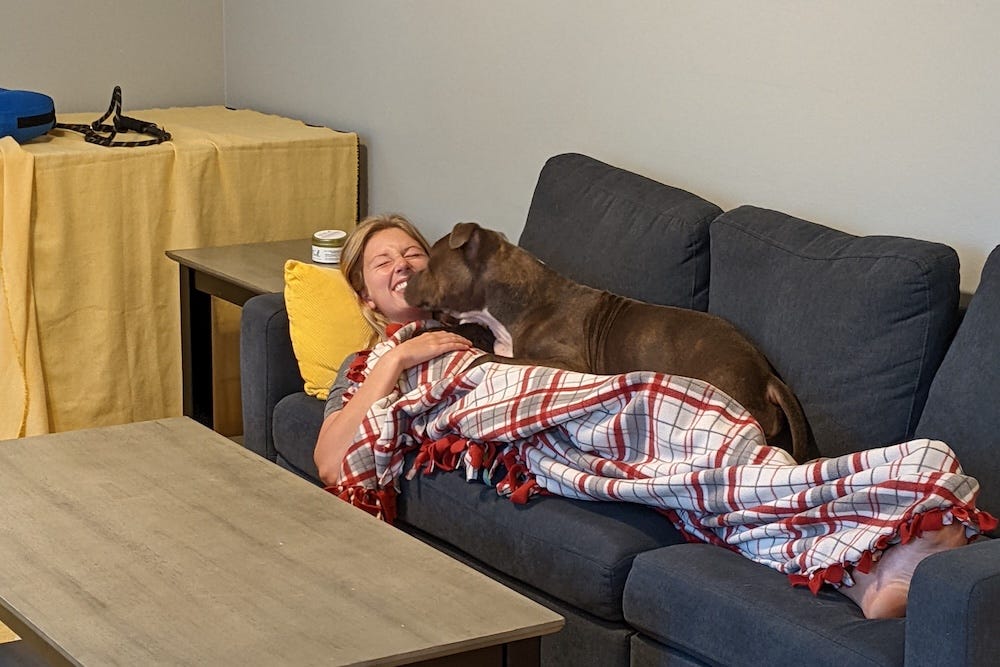
And not when we had to say goodbye (though it is difficult to let them go). Sean called it early on that the most challenging thing about fostering would be balancing my energy between all the creatures who needed my support.
My “emotional capacity”—the palatable phrasing I’d use in a job interview to convey that I feel everything at a tidal-wave scale, no small inklings or “reasonable” responses—is my favorite and least favorite trait. My partner and I were fortunate to have the logistical resources we needed to open up our home to a dog in need. I was years into intense work on myself that I hoped would give me the emotional resources I needed, too. But it was still not seamless!
I had some “only child syndrome” going on with Scout. After bringing Val into our previously stable equation, I felt stretched to the limit in opposite directions. I convinced myself, all in the same day, that I was the world’s best foster parent and also the world’s worst—some mornings I felt like a saint, some evenings I felt like the Most Terrible Dog Lover Who Has Ever Lived.
I’d love to conclude this with some rosy reflection about an epiphany that I was in fact good enough, a moment of clarity that enabled me to see and feel things for what they actually were, but that didn’t happen. Instead, fostering Val was an ongoing exercise in rollercoaster-y small incremental growth.

Non-social dogs can be good foster siblings
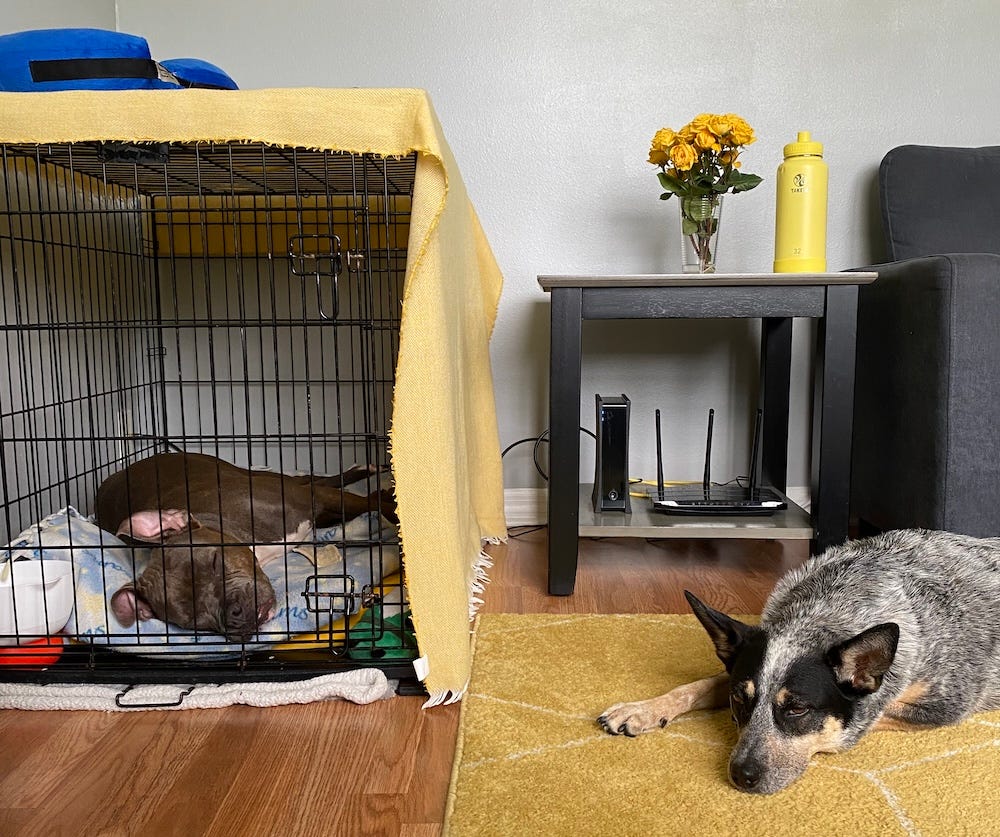
Despite feeling ready to foster—or at least as ready as we’d ever be—and knowing our house’s layout would provide flexibility when it came to integrating or separating our resident dog from our temporary guests, I was still worried. If Scout had a hard time sharing her space, would that negatively affect the other creature we’d promised to care for? This felt particularly salient in Val’s case, because she needed a calm, supportive environment to recover from significant medical trauma.
My hesitation wasn’t unfounded. These are all important things to think about (and I’d have been negligent to not consider them)! But all in all, what I learned from bringing another full-grown adult dog into our space was this: Non-social dogs can actually be helpful foster siblings.
Scout didn’t want to interact with Val. Given that Val was on crate rest with so many activity restrictions, this worked out better than if our blue heeler had wanted to be her new best friend. And even if Val was cleared to romp around with another dog to her heart’s content, I think the ability to ignore fellow canines is an underrated skill for modern pets to have. Scout’s reticence to get up close and personal with our foster created ideal opportunities to practice!
I do think fostering is loads easier with social, tolerant resident dogs. I admittedly still feel a little jealous when I see people for whom that is the case: Their canines can do a lot of the work to make a new addition feel welcome and confident, which takes oodles of weight off the human end of the leash. But I’m equally sure that Scout’s preference for calm coexistence over direct interaction didn’t hurt Val’s recovery in the slightest, and I’m quite hopeful it helped her develop foundational skills that will serve her for the rest of her life (which will undoubtedly involve not always being allowed to greet every other animal she sees).


“Fair” isn’t always “equal”
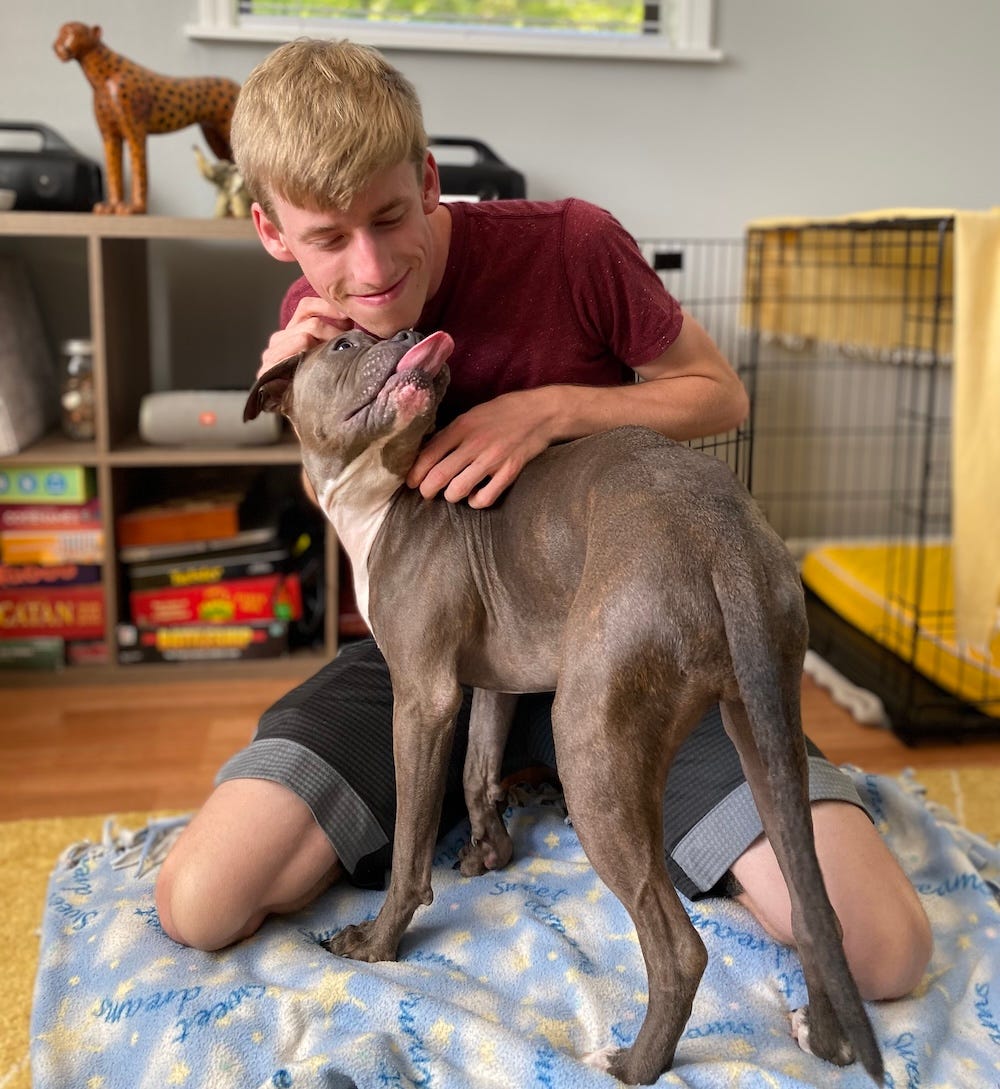
I am over-the-moon obsessed with Scout. It was also important that any animal coming into our home felt safe and seen and loved, too. How could I give everyone what they needed without drowning in guilt about not being a superhero who could stop and start time at will?!
The answer, it turns out, was to remind myself that being fair to all dogs in my care did not require me to treat them in equal ways. Sometimes I started to feel terrible about letting Scout snuggle with me on the couch while Val was crated nearby, or about putting Scout outside so our blocky-headed gal could roam the living room, or about taking our healthy cattle dog on a long walk when our foster could barely leave her bed (let alone the house). That guilt was natural, but it also wasn’t productive (or, you know, fair to myself).
Although I never wanted anyone to feel actively slighted, it wouldn’t have made a lick of sense to set a timer to make sure both dogs got identical time with us each day, or to keep Scout crated every second Val had to be, or to otherwise drive myself mad trying to make things even. What I did instead was ask what mattered most to each individual dog. What had the greatest impact on our shared life? What was my own capacity to give looking like each day? What would best prepare us all for the future?
Easier thought than acted on, of course, but the “fair not equal” refrain always helped.
Some dogs bark just for the sake of barking?!
My friends, I can’t believe how much this blew my mind. Scout has never vocalized much unless she’s acutely upset or incredibly amped up (like, overstimulated in an unhealthy way). Val, in contrast, talked incessantly no matter what was going on.
I do think part of our foster’s tendency to vocalize came from a lack of physical fulfillment—medically mandated crate rest is hard even in the best of circumstances—but the majority of her noises weren’t tied to how long she’d been confined or how recently she’d gotten to play or any other factor. She just liked singing the songs of her people.
Because my previous life with Scout had created a negative conditioned emotional response to barking and whining, exposure to Val’s “just because” noises was the best therapy I could have asked for.
Knowing one dog does not mean you know all dogs
Scout and Val were both thin and roughly the same height, but the similarities stopped there.
Floppy versus pointed ears move in different ways. This made Val’s body language subtleties harder to read since I’m so used to Scout’s upright satellites.
Scout’s eyes and facial tension show a lot of expression. Val’s face mostly always looked the same (unless she was panting). Over time I grew more accustomed to our blocky girl’s slight movements, but it took a really, really focused look.
Their snout lengths required different treat-delivery techniques. (Also, Val’s saggy lips meant a lot more drool cleanup. Oops.)
Val was afraid of things that didn’t faze Scout at all, and vice versa.
Although domestic dogs share many overall traits as a species, their behaviors and mannerisms and appearances vary. (A lot.) It was wonderfully humbling to learn another creature from scratch.
Surface-level looks never tell the whole story
Above all, our first foster experience reminded me how unfair (and unproductive) quick assumptions can be.
There were several moments in our time with Val where I’m sure we looked like a total trainwreck to the outside world. She cried the entire time we sat in the drive-through for her first pup cup. Overwhelmed with too many many sights and sounds and smells competing for her attention, she struggled to settle outdoors. She nearly pulled me to my knees trying to zoom around our front yard. She shouted with her whole chest when we brought her to wade in the river (and Sean had to carry her past a bemused-and-slightly-uncomfortable man trying to read his book in silence on the shore).
With Scout, I often get snagged on too-deep concerns about what other people think of us. Do we look put together? Can strangers tell that we’ve worked diligently to get here? Can I feel proud of our behavior?
Navigating the world with a brand-new foster dog was welcome—and desperately needed—perspective.

Other notes and news
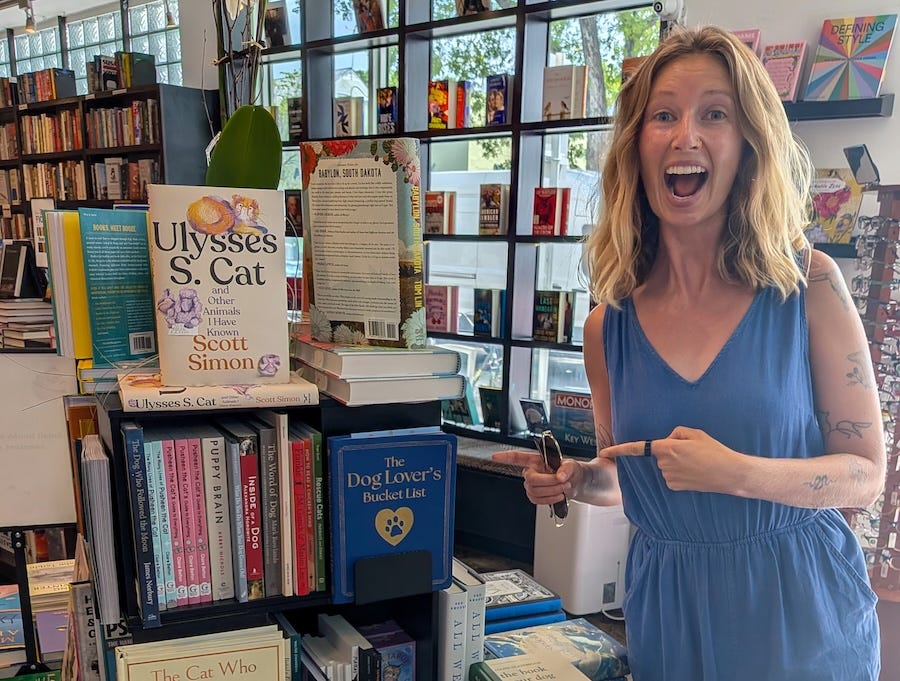
This week marks a full month since THE DOG LOVER’S BUCKET LIST hit bookshop shelves. (If you’re new here, that’s my first published book—you can read more about the process here!) I am overwhelmed in the best possible way by the kindness of my friends, family, literary community, and all the total strangers who have shared in the celebration.
June also means we’re more than halfway through our time volunteering at one of Florida’s busiest state parks. Our various obligations have been so demanding but also so fulfilling, and best of all: The very first sea turtle nests should hatch by the end of the month!
All my love to you and your dogs (and cats and rabbits and other beloved creatures).
I love everything about what you wrote. Fostering is emotional AND rewarding. Thanks!
Off topic, but I love your newsletter name!