


Hello hello, fellow dog lovers!
I first published a version of this article all the way back in June 2020. That feels like a lifetime ago (what do you mean I’d only had Scout for two years?!) but my sentiments still stand—and some recent retractable leash hate has inspired me to unearth and update this post.
Read on for what has turned out to be a surprisingly hot take in the dog training world.

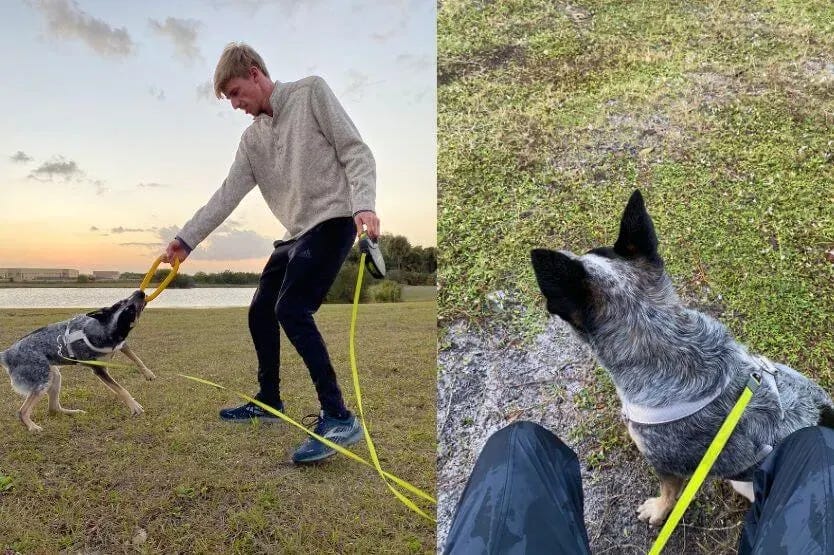
Flexi leads. Retractable leashes. Dog tape measures. Horrible tools that should be banned immediately. On-leash off-leash freedom. One of the biggest taboos in dog training.
Whatever you call them, there’s no denying that retractable leashes are a mixed bag in the dog world. At this point I might even argue that they are one of the most controversial tools we can put on our dogs.
When I tell someone that we love our flexi lead, I get everything from befuddled looks of shock (“aren’t you like, obsessed with being a responsible dog owner?”) to flat-out condemnation.

Finally, something different trainers can agree on?
While many tool debates seem to create “sides”—most of the balanced dog training community in favor of prong collars while the force-free community is against them and vice versa for front-clipping harnesses, for example—flexi leads often appear universally hated.
In fact, an anti-retractable comedy bit by a guy named Drew Lynch went viral across the dog community. Casual pet people and seasoned trainers alike enjoyed laughing together as he ripped on negligent dog owners in what’s admittedly a great piece of humor.
Give it a watch yourself, and tell me at least part of you wasn’t vehemently cheering along:
Good stuff, right?

When retractable leads go wrong, they go really wrong
Flexi leads can be dangerous. So can a multitude of other dog training and walking tools—I’d argue all of them, in fact—but there’s no denying that:
Retractable leashes are easier to misuse than their standard-length counterparts, and
When a flexi lead is used incorrectly, the consequences can be particularly extreme.
When you read the words “flexi lead”, what comes to mind? The first thing I used to picture was an out-of-control dog running a full block ahead of their owner. Barking at people, getting in the personal space of other dogs, ruining the evening walk experience of the entire neighborhood.
The vision got even worse if I imagined this in a city or crowded park—or when I remembered that:
Some of the folks simply minding their own business nearby might be afraid of dogs
The flexi-lead-wearing canine could trample protected wildlife or neighbor’s careful landscaping
Other pet owners being charged by this unfamiliar dog could have spent months building their dogs’ faith in handler to overcome fear reactivity only to be ambushed by clueless Jane Doe and her retractable leash
Yeah, that’s a yikes.
Flexi leads are known for a range of problems
The above scenario is often enough to completely turn dog owners off of retractable leashes for good.
These dog “tape measures” are notorious for plenty of other issues, too:
Constant leash pressure: Many dog trainers believe retractable leads teach dogs to pull by rewarding them with more freedom when they fight the line’s resistance. That’s pretty much the opposite of the understanding of leash pressure most handlers want!
Tangles: The thin, string-like flexi leash varieties can easily get tangled with each other—and they’re a nightmare to separate. This is especially dangerous in dog fight situations.
Breakage: Some more cheaply constructed (or worn out) retractable leads can split open in the middle of walk.
Poor grips: The hard grip of flexi leads can be difficult to hold, increasing the chance that they drop it and fully lose control.
Panic in dogs: If an owner drops their retractable leash, it can scare their dog. Because the handle reels in toward whatever it’s attached to, pets may feel as though they’re being chased—so they just keep running farther.
Injuries: Humans and dogs alike have been injured by flexi leads, particularly when the string gets wrapped around a finger or leg. Talk about a spectacular rope burn.
That’s quite the laundry list, right? It’s no wonder that jumping aboard the “flexi leashes are awful” bandwagon is the popular move.

But what if retractable leashes aren’t all bad?
In case the above sections aren’t clear: I don’t think that flexi leads should be the “average” owner’s go-to for every walk around the neighborhood.
But I do think retractable leashes can be amazing tools in the right hands. It would be remiss to write them off completely!

Any tool can be misused. Leashes. Collars. Harnesses. Food. So much of a specific tool’s success or failure lies in our hands as owners and trainers.
There is a time and place to use a retractable lead—just as there is a time and place to use a harness or some high-value treats or pretty much anything else.
Acknowledging that there might be situations where a certain tool is a good decision is not the same as recommending its use in every scenario. I don’t encourage the entire world to go out and use flexi leashes willy nilly!
But I do encourage responsible handlers to not be afraid of their benefits.
The “good side” of flexi leads does exist
Though their usage is wrought with problems, retractable leashes have plenty of great traits too.
I learned a lot about their responsible implementation from dog trainer Jay Jack, and I think his ebook says it well. Here’s a summary of what a properly used flexi lead can do for you and your dog:
Help teach leash manners: Jay actually uses retractable leashes to teach dogs how to walk politely on leash. It’s a fun, game-based style of learning that builds killer engagement.
Help sensitive dogs get used to pressure: Some dogs are really sensitive to leash pressure and shut down when it’s applied. Scout is a little bit like this. We’ve come a long way, but there are still times where any resistance freezes her in her tracks. Getting her used to feeling a small amount of pressure on our retractable lead has helped her become more confident!
Provide more freedom while maintaining control: Retractable leashes are perfect in situations where you think your dog would do well off leash, but you still want an extra layer of control just in case—or you want to respect the legislative intent of leash laws while allowing your companion more space to romp.
“Why not just use a long line?”
Many people (myself included) often use long lines to give their dogs more freedom while still having ultimate physical control. This works well in many situations—but flexi leads can be even easier to use because they manage the leash slack themselves.
This is important from an accessibility standpoint. And the convenience also helps if our goal is to increase owner compliance with the legislative intent of leash laws!
If a handler finds that their long line keeps getting tangled and dirty, they might be more likely to just unclip the leash altogether. If their retractable lead is conveniently managing the slack, though, there’s a greater chance that they’ll keep it on.
I’m reminded of Tim Ferris talking about the “best” strategy to achieve any given goal (a concept that blew me and Sean away when we were 21 years old). He concedes that the actual best method isn’t just the one with the greatest chance of success on paper—it’s the one with both a high chance of success and a high probability of compliance.
The convenience of a quality retractable leash can make it easier for owners to follow through on keeping their dogs from disturbing wildlife, the environment, and fellow park users even when it’s really tempting to throw caution all the way to the wind.
“But doesn’t the resistance teach dogs to pull?”
This point is often debated. I think the truth, quite simply, is that every dog is different.
Some dogs—especially those on the small end—might become desensitized to leash pressure if they always feel a retractable leash clipped to their collar. Others barely notice it.
Jay Jack once measured the resistance of his particular retractable leash model at about six ounces. He contrasted that to the smallest ecollar he could find at the time, which weighed about eight ounces.
Of course those two things aren’t directly comparable. But it stands to reason that a few ounces coming from different directions might not be that big of a deal. (This is especially true when we consider that dragging a long line also puts resistance on a dog’s neck.)
If we are nervous about the resistance of a retractable leash ruining our dogs’ leash manners, though, there’s an easy solution: attach it to a harness instead! We’ve taught Scout she’s allowed to pull into any back-clipping harness but needs to yield to leash pressure on a collar, and it’s been a great distinction.

We proudly—and carefully—use a retractable leash to have more fun together
I love our flexi lead. I think it’s awesome. Our retractable made some particularly enjoyable beach trips possible for us when we first moved to Florida—and it’s a regular choice for trail walks and park visits now that we live on the road in our van.
Some situations just lend themselves really well to a greater level of freedom without worrying over long-line slack!
Although I’m proud to say this is a tool in our toolbox, I hope it’s clear that we don’t use our flexi lead like clueless Jane Doe in the story up above. And you’ll definitely never find us in a Drew Lynch comedy bit 😉
Here’s how we use our flexi lead safely and respectfully
Being responsible is always important to us, and even more so when such a controversial tool is involved. (The same way I want to be a good ambassador for dogs and their people overall, I want to be a good ambassador for the tools we love!)
1) We treat our retractable leash a lot like being off leash
I only put Scout on our flexi lead in situations where I’d feel pretty comfortable with her being all the way off leash. We don’t use the retractable anywhere that’s crowded or confined!
For us, this often looks like sniffari walks to open natural areas. We like to go to parks and easy hiking trails when it’s raining, windy, or otherwise “terrible”. It means no one else is around and we can have the space to ourselves.
Honestly, it’s sometimes tempting to break leash laws entirely in truly empty situations… but we value the nearby wildlife (and the simple, delightful fact that dogs are even allowed at our favorite parks, beaches, and other spots at all) too much to give in.
We also don’t expect the leash to be our only connection to Scout. Her recall and desire to simply stay near us of her own accord need to be solid, too.
2) We only use an all-belt, ribbon, or tape flexi
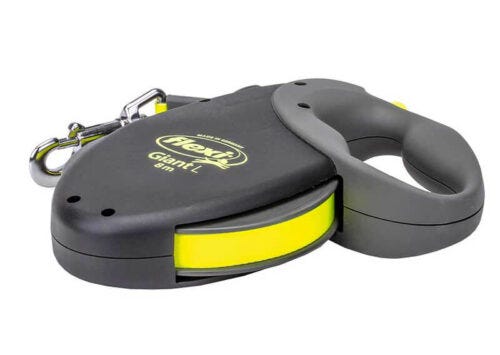
No cattle dogs on a string here. Our flexi leash is a tape variety, sometimes also called belt or ribbon. The entire length of leash is a fluorescent flat belt, which serves a few different purposes.
The thicker line is much easier to untangle than a thin string would be.
Folks can see the entire length of leash from far away, so even at a distance they know that Scout is attached to us and under control. Hopefully this eases the minds of people who might be afraid of off-leash dogs!
We can grab it, if needed, without worrying too much about rope burn.
The line is less likely to snap or break if it gets caught on something.
3) We regularly check that our leash is in good shape
As with any tool, I understand that our retractable leash could break. Before using it each time, we check that it’s still in good condition with no obvious signs of acute damage or excessive natural wear.
4) We usually attach our retractable leash to a harness
We’ve taught Scout that she can pull into a harness but must yield to leash pressure from her collar. Most of the time, we attach our flexi lead to her harness so that the slight resistance she feels doesn’t run the risk of upsetting her leash training.
As our time together has gone on, we have started sometimes attaching the retractable leash to her collar now. It’s such a slight amount of pressure that it’s never been a big deal for our individual situation—and I’m happy to say her (fairly stellar, if I may boast for a second) leash manners have remained intact.
If we decide to attach the flexi to her neck, we make sure of a few things:
The collar is wide (1.5 inch minimum) so that the resistance is distributed over a large surface area.
It’s also loose enough to turn around her neck so that the pressure doesn’t always come from the exact same place.
The collar buckle is not cracked or at immediate risk of breaking under force.
5) We bring a standard leash along with us as back up
A retractable leash is rarely the only walking tool we have with us. We typically bring a standard fixed-length leash along too!
One of my personal favorite combinations is to attach our flexi lead to Scout’s harness and then carry a slip lead in my pocket. This way I can quickly recall her and put the slip over her head if we come in close proximity with other people or dogs.
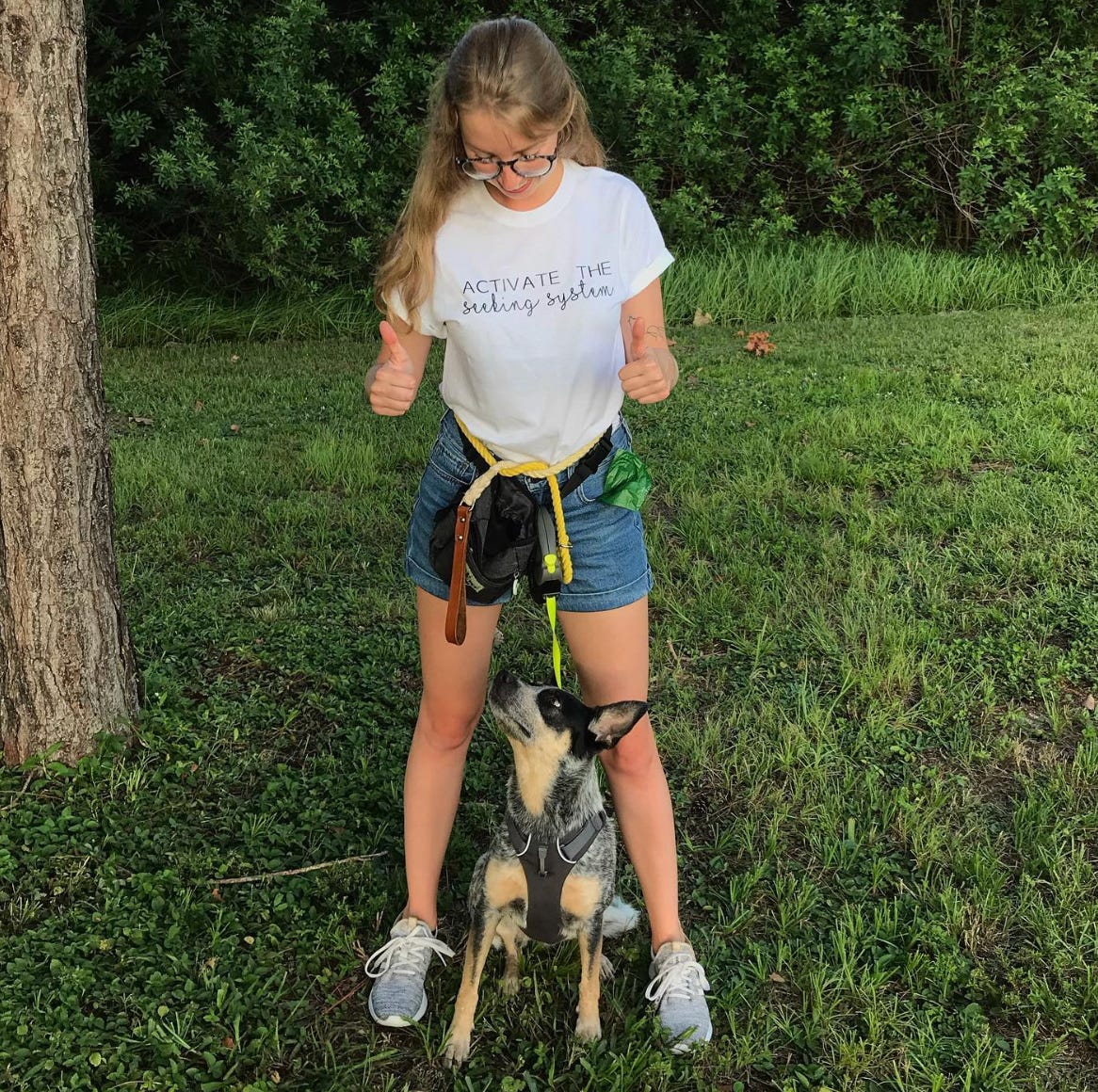
We’ll also often go somewhere with Scout on her six-foot leash and bring the flexi along just in case the opportunity arises. When entering the beach boardwalk, for example, she can wear her regular lead for optimum control in a tigher space—and once we confirm that the beach is empty, we might then decide to switch over to the retractable.
Another possible solution to this is to simply lock the flexi when in a smaller area. I don’t think this gives quite the visual cue of “under control” that a standard leash does, but it’s reasonable in many situations!

Despite popular opinion, not even retractable leashes are black and white
If a flexi isn’t the tool for you? Cool! No biggie. That doesn’t mean it can’t be the tool for us. Flexi leads aren’t as obviously terrible as many dog owners and trainers make them seem.
In the right hands, retractable leashes can be a wonderfully responsible way to enjoy more freedom with our dogs. In the wrong hands, they can be disastrous. (Reminds me of several other dog training tools, too.)
I think one of the most important things we can do as responsible guardians is keep an open mind. When we consider different perspectives and take the time to think through situations (instead of passing instant judgment) we can learn, grow, and ultimately do more for our dogs.
You won’t find me encouraging everyone and their brother to go out and buy a retractable leash tomorrow… but you also won’t find me hiding the fact that we own, use, and love one ourselves. Happy flexi-ing!
Came here to argue. Leaving with a head nod. The comparison to off leash is absolutely correct, otherwise I strongly encourage pet parents not to use one.
If a dog walking client provides us with a flexi leash, we will bring our own and not use it. It's an advanced training tool not an everyday leash, especially for the hired dog walker.
I do appreciate your perspective though because you are right that I was too quick to categorize others who use one, not as a bad dog owner but a misinformed one. I can definitely understand why it works for you and is a good choice. Plus more pictures of Scout is something I never regret seeing. Thank you for sharing.
I always enjoy your "hot takes" (which are really just "I thought about this for more than three seconds without getting angry... takes"). I also completely agree that most tools have a place in qualified hands. After all, if nine out of ten chainsaws were operated by toddlers, we would all be condemning chainsaws.
In practice, though, I'm not sure I can be seen in public walking a doodle on a flexi! Any responsible dog person we encountered would burst into flames.