


Two and a half years ago, my then-baby niece received a board book called That’s Not My Kitten. It’s a simply illustrated story about a narrator trying to find their cat via sensory details. My niece loves animals—especially cats, as she’s grown up with them!—and so of course loved this book with its interactive touch-and-feel details.
I loved it too. (The whole series is darling.) My only gripe? On every page, the book refers to the various kittens the reader encounters as “it.”
That’s not my kitten, its nose is too smooth. That’s not my kitten, its tongue is too fuzzy.
So I got permission from my sister and brother-in-law—the adults ultimately in charge of decisions regarding my niece’s belongings—to change the book. I crossed out every instance of the pronoun “it” (which we most commonly use to refer to inanimate objects in English) and replaced them with the gendered pronouns we use for fellow people. I recorded a short video showing my copy tweaks and shared it to my dog Instagram account.
I felt proud of the example I was trying to set for this small kid I so deeply adore. Pets aren’t things. They’re individual, sentient beings like us!
The internet both did and did not see my intervention the same way. Although big organizations like PETA asked if they could repost my reel, hundreds of other commenters expressed their distaste at what I’d done—either because I wrote in a book with a permanent marker (oops, I hope these folks never realize one of my great joys in life is annotating printed pages) or because I was arguing against “proper” grammar (officially, English calls for “it” to refer to nonhuman creatures unless they have a close relationship with a person) or (most understandably, and a criticism I took to heart in future edits) because I’d neglected to include a range of neopronouns in my changes.
When the vitriol peaked with some truly disgusting insults, I deleted the whole post. (I am still too much of an Internet Person, but I am not willing to go through that level of adrenaline just for views.) I never did give PETA or anyone else permission to amplify the reel.
Now the topic has come up again in some recent reading—I’ve seen “it” used to refer to nonhuman animals in several articles written by professed pet lovers and in a bestselling dog-centric anthology—so I wanted to reshare my thoughts. Language is messy! It always will be messy: We come to conversations with our own preexisting ideas and experiences and connotations. But I still believe in taking words seriously, thinking about their impact, and, if nothing else, chatting about why we feel the way we do.
Here goes.
Nonhuman animals aren’t inanimate objects
As the International Society of Zooanthropology says: Our fellow creatures aren’t automata. As Humane World for Animals echoes: “Calling living beings ‘it’ can subtly reinforce longstanding rationales that prop up abuse and exploitation.”
If you’ve been here for any length of time, you know I do not buy into the idea that humans exist at the top of some arbitrary scale from least- to most-valuable beings. Our insistence on being the “only species to have ___” (insert your favorite example here; erroneous claims so far include language, tool making, and mental time travel) has hindered nonhuman animal research and stunted our capacity for interspecies empathy. Instead of evaluating fellow creatures in their own contexts, we too often judge them in ours. I think casually using “it” is tied to this implicit demeaning.
While drafting this piece, a red-winged blackbird perched atop the arm of the empty chair next to me. The chair does not live or breathe or think or feel, and I am happy saying it is yellow; it is comfortable to sit upon; it held the bird’s weight nicely. But referring to the bird the same way—looking into their eyes, seeing them maneuver, then using the word I use to reference an inanimate piece of furniture—feels wrong.
It’s not that my dog or your cat or that red-winged blackbird or any other creature without a strong grasp of human language cares what words people use about them. They have literally no idea what those words mean. (I don’t get offended when a stranger assumes Scout is a “he,” for example; it does not automatically affect how they make her feel.)
But the words we use affect how we feel. I don’t know anyone respectable who believes in the strong Sapir–Whorf hypothesis—linguistic determinism is reductionist—but linguistic influence is widely accepted for good reason. Is it possible that some people can use “it” for animals without the pronoun fundamentally changing how they view and treat nonhuman creatures? I’m sure it is! But it’s equally possible that this subconscious use worms into our thoughts and beliefs in insidious little ways, and we might as well embrace new norms that prevent that possibility altogether.
Grammar schmammer (sorry not sorry)
One reason “it” is so common to refer to nonhuman animals is because the pronoun is still, officially, grammatically correct. Unless an animal is “personal”—meaning they have an intimate relationship with a person or are anthropomorphized to talk in a children’s book, for example—most style guides insist we use it rather than singular they.
But grammar constantly changes. Saying “well, that’s just how it’s always been done!” and “well, that’s just what the Powers That Be have decided is right!” isn’t a good enough reason for me to keep making a choice.
A real perk of my writing primarily for pet-focused publications is that editors don’t argue with me when I say “the dog who” instead of “the dog that” or use singular “their” instead of “its” or otherwise embrace our fellow creatures as beings with minds and emotions and value. I think we’re seeing an overall shift here outside of animal-specific contexts too. (At minimum, more people are talking about why and how and when these pronoun choices matter.)
What about people who prefer it/its pronouns?
Now, this whole conversation gets messier because some humans prefer to be referred to with it/its pronouns. I can’t be clear enough here that I fully support this choice. (My friends, the very bare minimum we can do is use people’s preferred pronouns without question!)
The problem is that the vast majority of folks I see calling animals “it” aren’t intentionally using a neopronoun. They’re just doing what comes naturally—what they were taught in school, what our “humans are the ultimate species” beliefs have instilled. They’re saying a dog is an it the way a chair is an it. They’re using the pronoun we’ve historically reserved for inanimate objects and creatures “less” than human.
I wouldn’t call a person “it” without them explicitly telling me that’s what they want. We default to singular they for people (like in middle school when my teacher announced “someone left their phone on their desk,” not “someone left its phone”) and so, in my mind, it’s sensical to do the same thing for nonhuman animals.
Language isn’t everything—but it’s is something
I probably need to start paying Anne Curzan for how often I reference this line in her book Says Who? A Kinder, Funner Usage Guide for Everyone Who Cares About Words. She sums it up too well:
“When people say, ‘It’s just words’ as a way to dismiss the power of language, you should be suspicious. Words often have consequences.”
And in a world where animals who aren’t human routinely receive unfair, thoughtless treatment? The consequences of our words are particularly important to me.

Other notes and news
Well, this is it, my friends and fellow creature lovers: My first book, THE DOG LOVER’S BUCKET LIST, was officially released by international publisher Quarto yesterday! (This inspiration-education-journal contains no instances of “it” referring to nonhuman animals 😉)
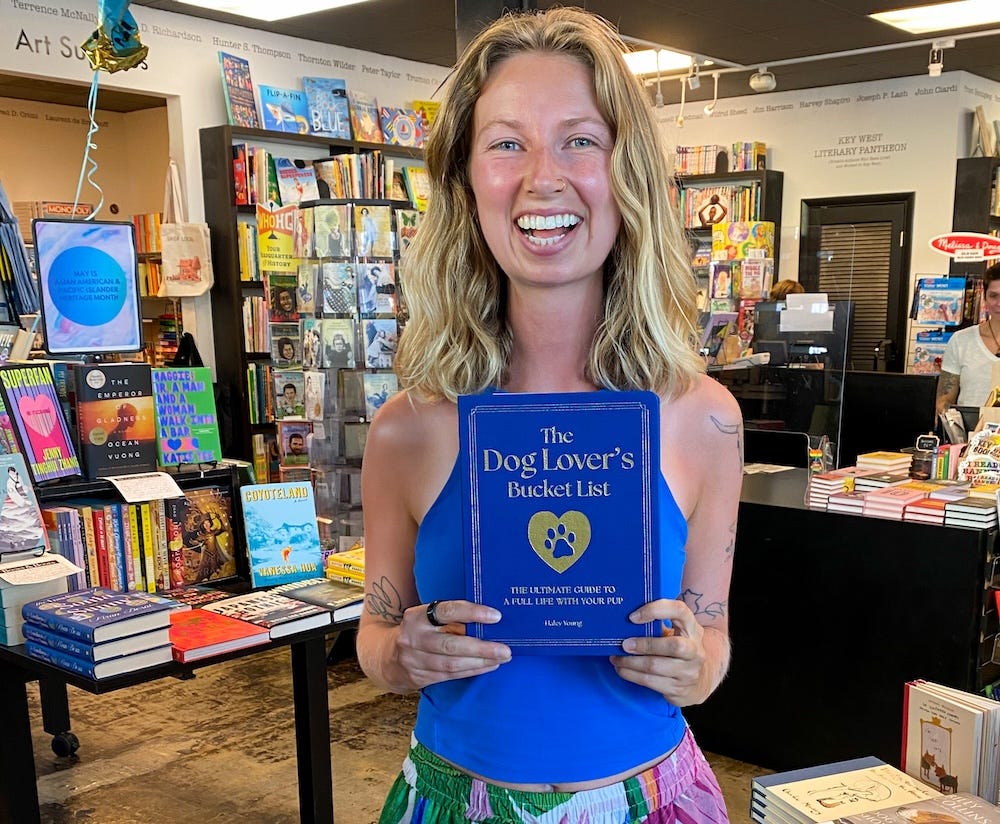
I plan to share some longer reflections on the whole process—from initial editor reach out to standing in a bookshop holding a volume with my name on the cover?!—soon. For now: Thank you so very much for supporting me and Scout.
I had this song going on repeat while I was reading this. https://youtu.be/CduA0TULnow?si=uEPLlsBp_84vQUL4
On the serious side, this is a well written piece. To a companion animal their pronouns don't matter to them, but you argue convincingly that words do matter. When we 'other' with "it" we diminish their agency and value. Thank you for sharing. Congrats on the book
THANK YOU THANK YOU THANK YOU!!! I feel a little jolt every time I read "it" for a nonhuman animal, and have been struck by how this unfortunate practice appears even in dog-centered writing. I hope this post goes viral and yields the change we need-- because words DO matter and can shape our worldview.
I am truly grateful to you for your clarity and compassion in raising awareness about this!❤️🐾