


Scout was trotting along a street near my dad’s work when the Humane Society of Marathon County picked her up in late 2018. A little under a month later her stray hold had expired—no one came for her—and she lived in a kennel on the adoption floor. When my family dropped off some holiday donations, I fell in love with the “shy but sweet” blue heeler’s pointy ears and speckles. (It took her a little longer—and was less about superficial attributes, thank goodness—but eventually she fell in love with me back.)
Now we’ve been together for seven years!
But thanks to her murky past, we’ve never known how old Scout is. Our guiding pieces of information included:
She had all her adult teeth when she was found. This means she must have been at least eight months old.
Those adult teeth had some wear. This suggests she wasn’t a fresh adolescent.
Aaand that’s pretty much it.
The shelter estimated Scout was between one and two years old. Our first vet guessed two to three. Our next vet concurred with the first. I decided we just had to pick something, so I accepted “one to three years old at adoption” as the overarching range and put “two years” on her official records. (Right in the middle, you know?) We celebrate her “birthday” on her gotcha day, January 13th, which means she could be anywhere from eight to ten right now.
I never thought much about how old Scout actually was until she started slowing down. She seems to have aged enough in the last year and a half that I’ve started reminding myself of our high-end estimate—it’s possible she’s already ten?—because I’d rather think she’s older than she is (and thus be pleasantly surprised by how much time we have left) than be blindsided thinking she’s younger.
Let’s test her DNA
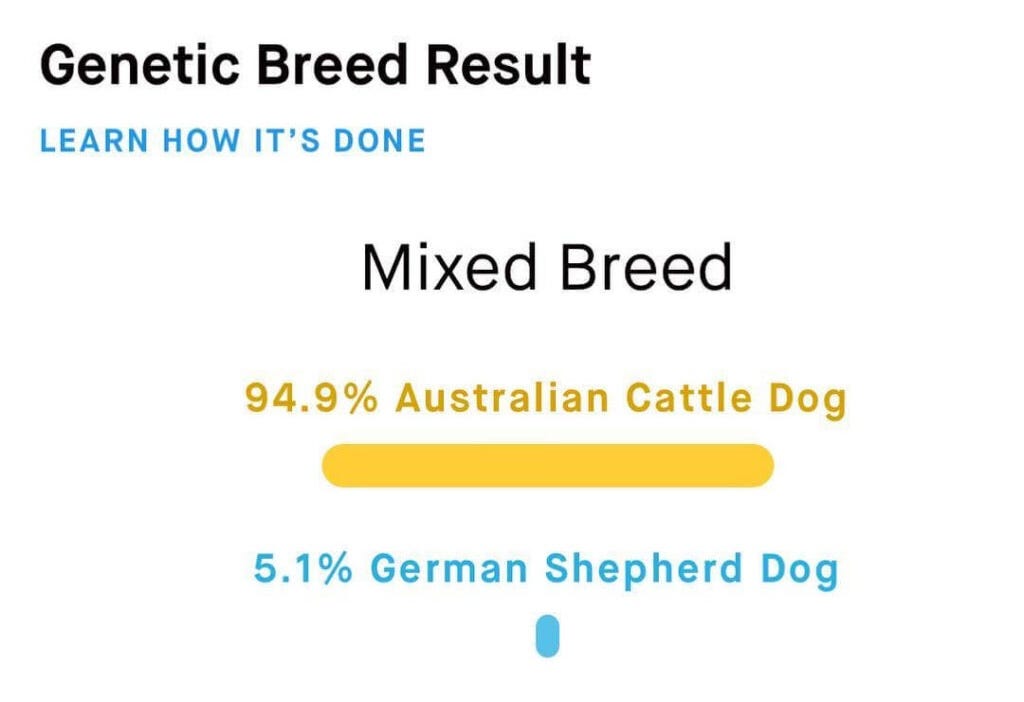
Our first spring together, I did an Embark DNA test to determine Scout’s breed makeup. (Although it is hard even for canine professionals to visually identify dog breeds1, Scout is mostly what you’d think she is: 95 percent Australian Cattle Dog.)
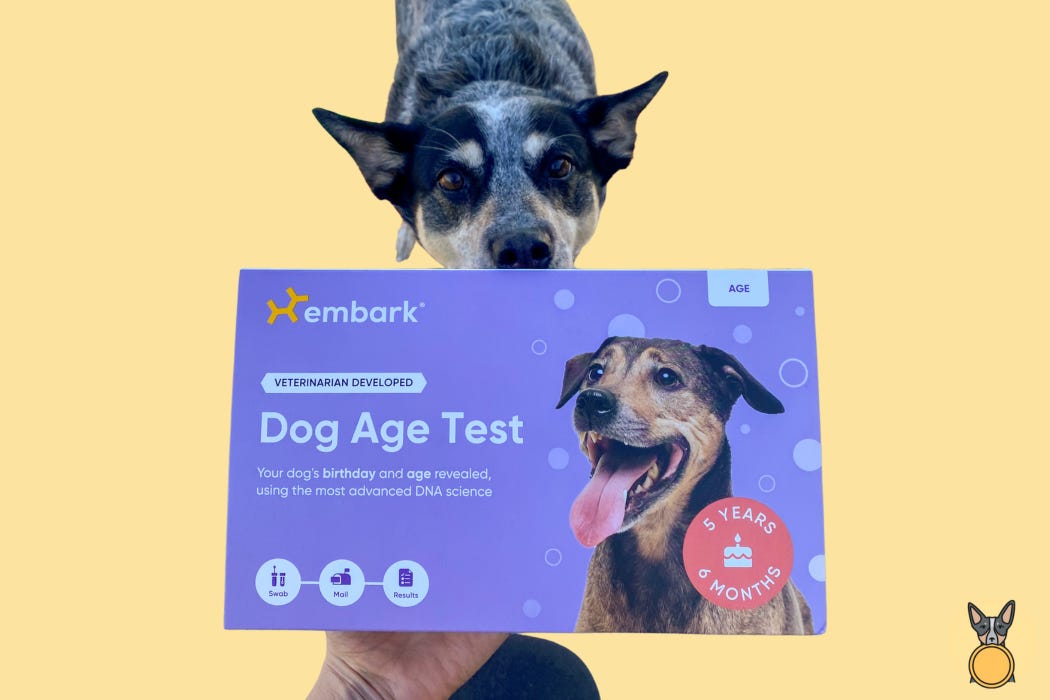
Embark has since introduced a Dog Age Test (that’s an affiliate link, by the way!) that had me intrigued. “Age can be notoriously difficult to judge in dogs based on visual cues alone,” notes science writer Mimi Padmabandu on the company’s website. No kidding, I thought, wondering not for the first time how our guesses were so up in the air. Maybe this test would let us narrow our estimate down?
Well, maybe. As it stood, we had a two-year range—Scout was somewhere between one and three when I brought her home—and Embark’s methylation analysis returns a result within 18 months of a dog’s true age 90 percent of the time and 22 months of a dog’s true age 95% of the time. In short: We’d generally accept that Scout is plus or minus 22 months (nearly two years) from the estimated age of her test.
But I was hopeful that 1) Scout’s result could help us lean to one side or the other of our estimated range, and 2) her DNA methylation profile might tell us something about how she’s aging. “DNA methylation is the most well-known type of epigenetic marker,” explains Padmabandu, and epigenetic clock predictions might be associated with physical capabilities. A 2022 Frontiers in Psychology article suggests methylation might also be correlated with fear-related behavior. (More research is needed to even start drawing any real conclusions here, but of course this caught my eye because Scout’s baseline is so much more fearful than most dogs.)
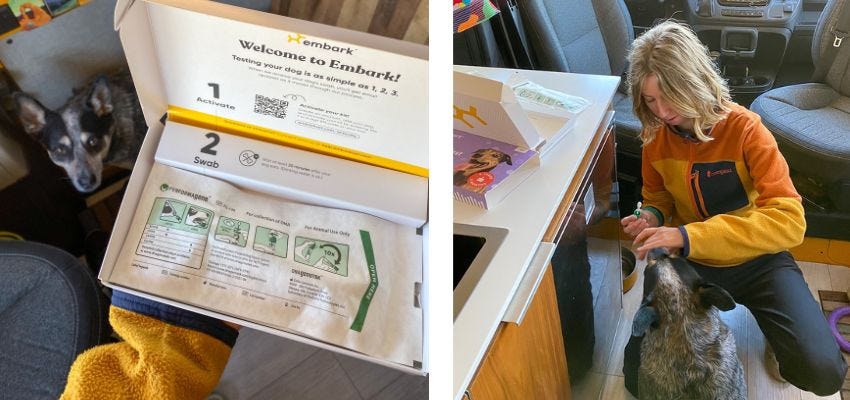
So we decided to do the test. We picked the small package up from a post office in California (S/O General Delivery services for van-life nomads like us!), swabbed Scout a couple days later, and sent it off in the mail.
Her results came back surprisingly quickly. Based on email updates throughout the process, Embark received Scout’s DNA sample on 12/10—and they had the reveal ready for us on 12/23. (A fun lil’ early Christmas present!)

When I clicked through, though, I did end up having to stifle a laugh. Scout’s estimated age is 7 years, 2 months, the website proclaimed. Scout’s estimated birthday is: October 21, 2018. (Below that was an “orient yourself with the times” tidbit: In the year 2018, the song “God’s Plan” by Drake was topping the U.S. pop charts.)
When Scout was picked up as a stray on November 28th, 2018, she definitely wasn’t five weeks old! 😉 But we knew we’d be getting a prediction interval with this age test—not an end-all-be-all accurate calendar date—so it was easy enough to shake off the initial shock. “The test is designed to predict calendar age and is most helpful when interpreted alongside what’s known about a dog’s background and history,” Embark reminded me. “There can still be a natural margin of uncertainty from dog to dog, influenced in part by biological differences and environmental factors that may affect methylation patterns.”

Based on Embark’s statements of accuracy:
77 percent of dogs have a true birthday within 12 months of their Embark Age Test result. Scout could have been just over a year when she was found.
90 percent of dogs have a birthday within 18 months of their result, which could make her as old as eight years and eight months.
Or she could be in the 90 percent who have a true birthday within 22 months, putting her at nine years old when she was found.
And it is unlikely (though not impossible) that she is already ten. You know I love seeing that!!
If I was really determined to narrow down Scout’s age, I’d want to run a bunch of these tests and graph how all the results came back. Of course, that is cost prohibitive (not to mention just plain unnecessary even for someone as over-the-top as me) so this is good enough! Her test largely matches our initial estimates, and I’m feeling pretty content to stick with our initial range: Scout was probably between one and three at the time we adopted her. Plus I’m not complaining that her methylation profile potentially looks like that of an even younger dog than we’d expect.
I think this age test is most beneficial for dogs who were adopted as fully grown adults in situations where vets had a particularly hard time estimating how old they might be. If your existing guess is around a two-year range, the test won’t tell you much more than you already know (unless that initial estimate happened to be way off to start with). If you’re working with a much wider spread, though? It could be fun (and useful) information to have!

There are a couple affiliate links to Embark in this post. They sent me their Dog Age Test in exchange for me sharing my experience—it’s a product I’d have bought, and a post I’d have written, regardless (a core tenet of any partnerships I partake in). Importantly, the brand had no creative control over this blog. All thoughts are my own!
As always, I am here for any and all questions you may have. And as always, please don’t feel pressured to buy anything you don’t actually need. You will never find a hard sell here (unless I publish my dream Paws and Reflect memoir someday, in which case I will be begging you to preorder in all capital letters 😂)

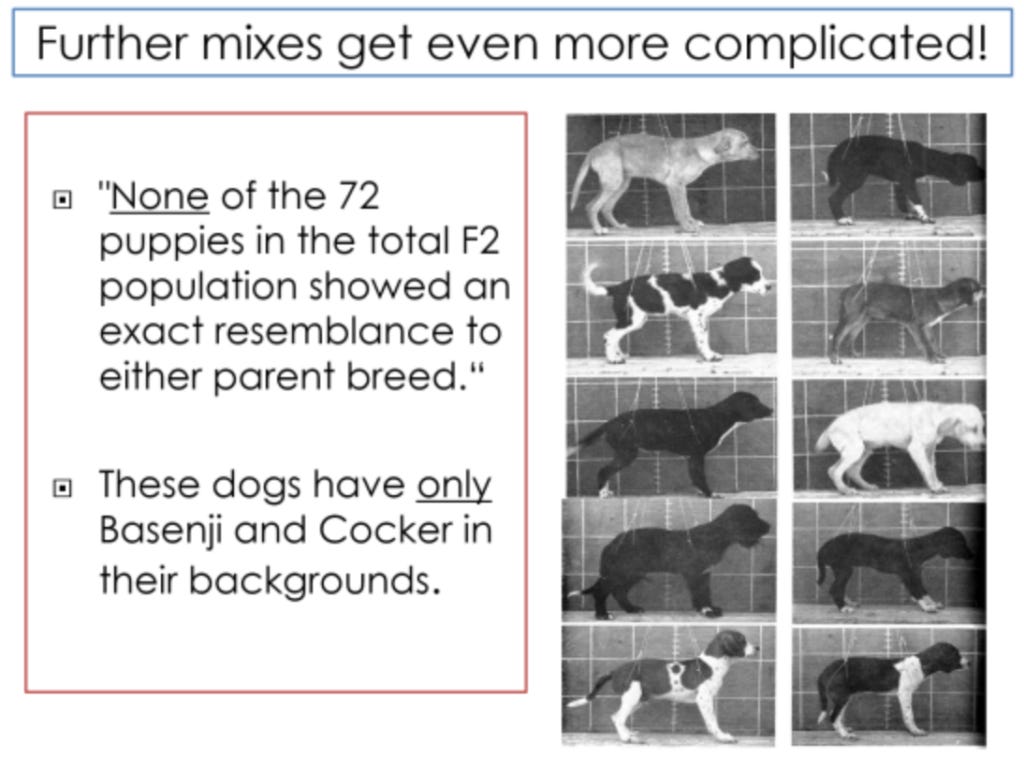
This was one of my favorite takeaways from Pit Bull: The Battle Over an American Icon by Bronwen Dickey. If you want to be shocked, take a look at this graphic from John Paul Scott and John L. Fuller’s Genetics and the Social Behavior of the Dog.
I will definitely buy your book when (not if!) it's published! Without any real evidence to back this up, I imagine it's a good sign that Scout's DNA tests younger than she can possibly be. Age well and slowly, cattle dog.