


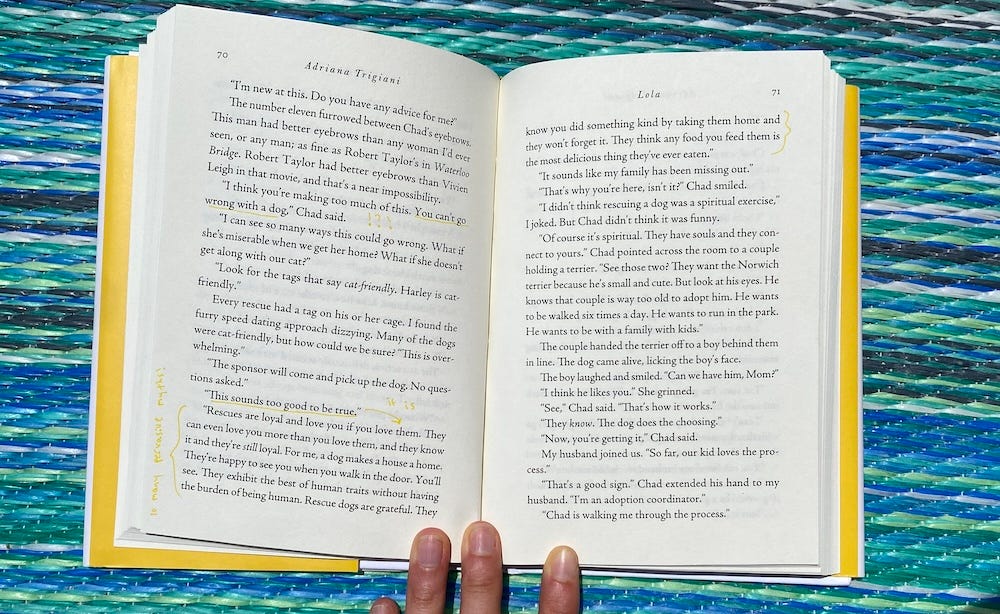
I just finished reading The Best Dog in the World edited by Alice Hoffman. There are multiple moments worth mentioning (and enjoying!) in the book’s fifteen essays, but I find myself stuck on two interactions. First, an adoption coordinator at a rescue event insists that:
“You can’t go wrong with a dog. … Rescues are loyal and love you if you love them. … Rescue dogs are grateful. They know you did something kind by taking them home and they won’t forget it. They think any food you feed them is the most delicious thing they’ve ever eaten.” (emphasis my own)
And later, a different humane society employee tells a different writer that:
“[This dog] is very skittish. She’s had some hard times, but she’ll recover completely with love.” (again, emphasis my own)
I read those passages, and I felt lonely. I reread those passages, and I felt angry. I spoke the sentences aloud to my partner, and he laughed: “But no one believes that all the way, right?” he said.
“I think too many people believe it,” I answered. “And if it doesn’t feel true for someone else, they’re quick to assume that person is the problem.” No bad dogs, only bad owners, right? Your dog is your mirror, right? All dogs need is love, right?
Oh, dear reader, I want to shout from the rooftops that these generalizations are wrong.
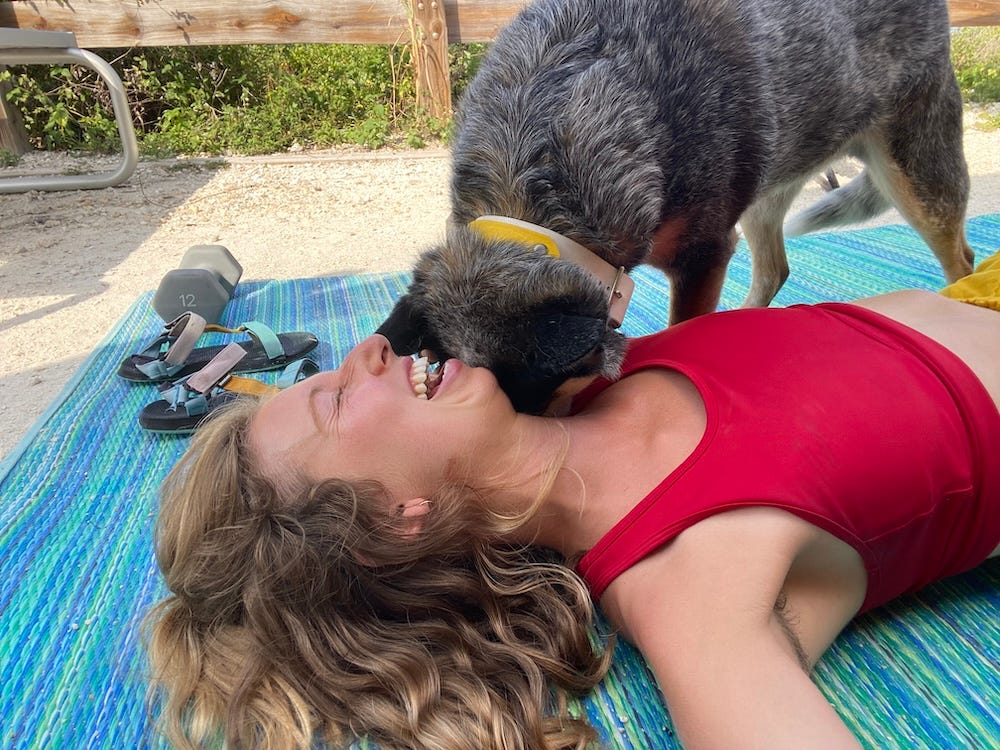
Domestic dogs are incredibly intelligent social beings. They’ve coevolved with humans for tens of thousands of years. I do think our pets are capable of feeling gratitude—their emotional wells run deep, far deeper than many of us care to realize as we go about our busy people-centered lives—and they’re absolutely attuned to our behavior!
But dogs aren’t privy to the machinations of human society. They do not understand our abstract verbal language or grow up with our species-specific norms or catastrophize into the future about what their lives could have been. When we take them from one stressful environment (a row of shelter kennels) into another brand new (our apartments, our houses, our converted campervans) they do not know what’s happening the same way we do.
Scout was not grateful when I brought her home seven years ago. I don’t mean she was actively ungrateful—just that there was no reason she should have thrown herself at my feet like I was her savior. No way she could have gotten all the intricacies of the situation. As far my new cattle dog realized, I was a near-stranger she’d only met twice, a (hopefully) pleasant presence she was curious about but did not implicitly and fully trust.
That trust came later. That trust came through consistency and curiosity and work (on both ends of the leash). And gratitude did follow: I believe, now, that I can read the look Scout gives me when I offer her a frozen bone in Florida’s sweltering heat, or pour some of my own water bottle into her empty bowl, or help remove a stubborn bur from her right ear, or put myself between her and an oncoming off-leash dog. We dance together. We play and orbit and lean and take turns. We fit. We love. It is beautiful.
But it would have been unfair of me to expect her to know, all those years ago, from the first moment I loaded her into my unfamiliar-smelling car, that I was “rescuing” her. It would have been unkind of me to think that because I was doing this Good Deed, her only reasonable course of action was to meet all my emotional needs and never express her own opinions and resist causing me any problems. (Oh, gosh, did she ever cause me some problems.)
There are times when shelter stories truly are rosy. I’m happy for those dogs and guardians! I’m glad that instant-joy dream remains alive and well, and I’m thrilled when it becomes reality. But saying every adoption tale is destined to be smooth—like possibly confused and stressed dogs are supposed to be instantly grateful, to never have dietary restrictions or require breed-specific fulfillment beyond a daily walk, to subsist on a cozy feeling of “love” alone—doesn’t help anybody.
It hurts.
It hurts the pets who find themselves struggling to adjust to a new situation and the handlers who don’t feel ready to guide them through. It hurts the guardians who were promised a seamless bond and now feel like failures because this relationship that should be “easy” is proving quite difficult, actually. It hurts the dogs who are nervous, withdrawn, unsure—and then get labeled “ungrateful” because gosh, we literally saved their lives, isn’t the least they could do let us snuggle them on the couch without complaint?! (Real comment I saw on a social media video about a dog who didn’t want to be pet the other day: “Dogs should always take petting. We care for them and they are supposed to do their job for us in return.”)
Scout didn’t know I rescued her. She didn’t understand what happened when animal control picked her up wandering the streets, when her stray hold expired at the shelter after no one came looking, when she was put up for adoption and stress-chewed her way through everything soft in her kennel. She didn’t know that my face meant freedom. How could she have?
Our bond wasn’t automatic. And I think, looking back, that this relationship is sweeter for the effort it demanded. I’d rather be chosen day in and day out because of my ongoing actions than lauded in perpetuity because I simply signed an adoption contract.
Love is part of it. Oh, gosh, please don’t misunderstand me here: Love is so much of it. But I think we can talk about and honor and highlight that love without slipping into generalizations that might make someone else feel small. Our journeys to our unique dog-human bonds look different for each of us—and that’s okay.

Other notes and news
Oh goodness, things have been so very busy lately (in mostly good ways).
First up: In less than a week (!!) I get to call myself a published author! THE DOG LOVER’S BUCKET LIST officially enters the world on May 19th. It’s been almost a year since senior acquisitions editor Nicole James reached out to me about this project (Nicole, I will never be able to thank you enough for your trust) and it sure felt special to get to hold the finished book in my hand.
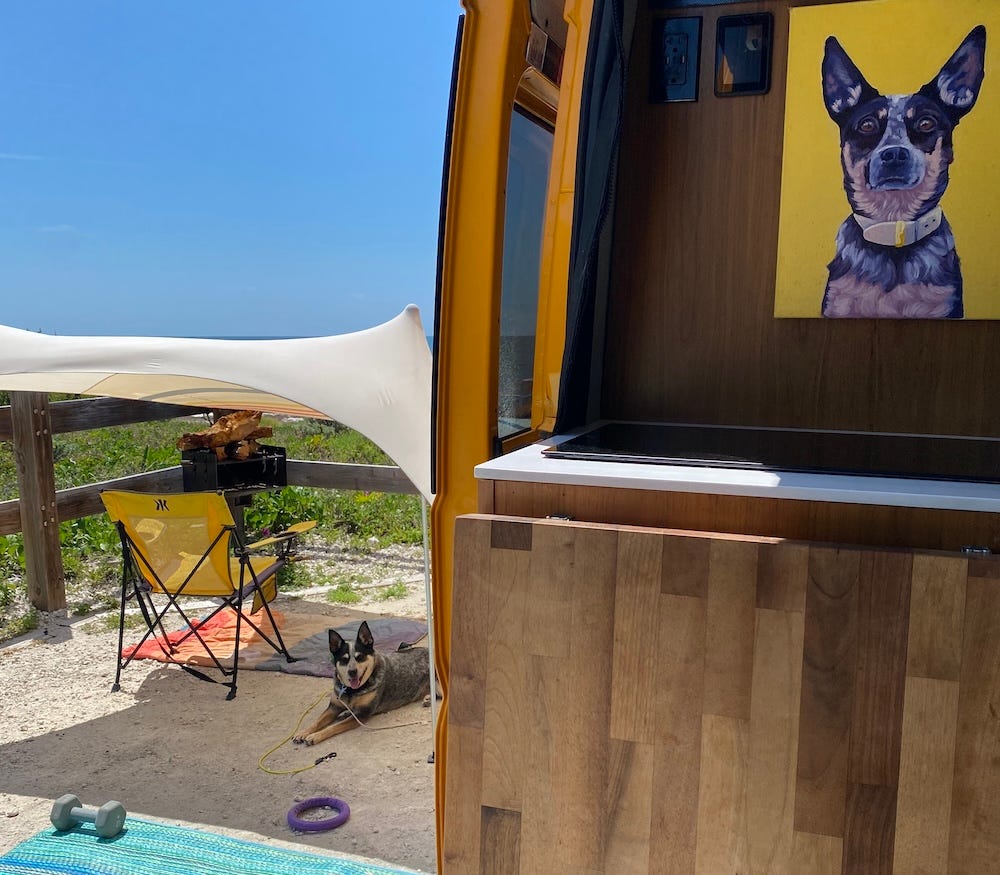
Next: We’ve been campground hosts in Florida’s twelfth-busiest state park for exactly six weeks! Time is flying by. We’re all a little hot, but Scout seems pretty darn content—see below for a photo of her relaxing in her shady kingdom—and continues to make me pretty darn proud.
Last, I’ve been (finally) dipping my toes into the “query trenches” with my book proposal for the PAWS AND REFLECT: LESSONS IN LIFE WITH A SENSITIVE DOG memoir. Part of the reason I care so much about this project is exactly what inspired today’s post. There are many wonderful dog-centric books out there! But I find that they often—even when gorgeously written and well intentioned and otherwise lovely—end up repeating some of these romanticized generalizations (or, in the case of the above examples, showcasing how these myths persist in in-person interactions). I realize my experience with Scout’s fear and reactivity isn’t everyone’s experience, and that’s exactly my point. I mean… there’s a reason I call this newsletter a “nuance-letter.”
Love to you and your dogs (and other creatures) 💛
Yet another of your kindly put reminders to look around us at the vast array of experiences out there! While I'm acutely aware that my dog-adoption story is not normal, I don't often think about the more common scenario where a strange person shows up at a shelter and takes the dog to a strange place to begin a strange, new life. That has to be jarring for everyone, even if it's ultimately good for everyone, too. As far as people who think dogs should "always take petting" because we take care of them...I wonder what kind of parents they are or would be to human children. Oy.
Dogs DO NOT UNDERSTAND HUMAN NUANCE! Anthropomorphizing animals is damaging to relationships. Thank you for writing this!